Wolf Range Repair
Why a Wellesley Wolf Burner Sparks and Never Catches
A Wolf burner that sparks and never catches is rarely a failed igniter. Separate the burners that spark from the ones that light, clear the cap and ports, then look at the electrode, the gas supply and the switch behind the knob.
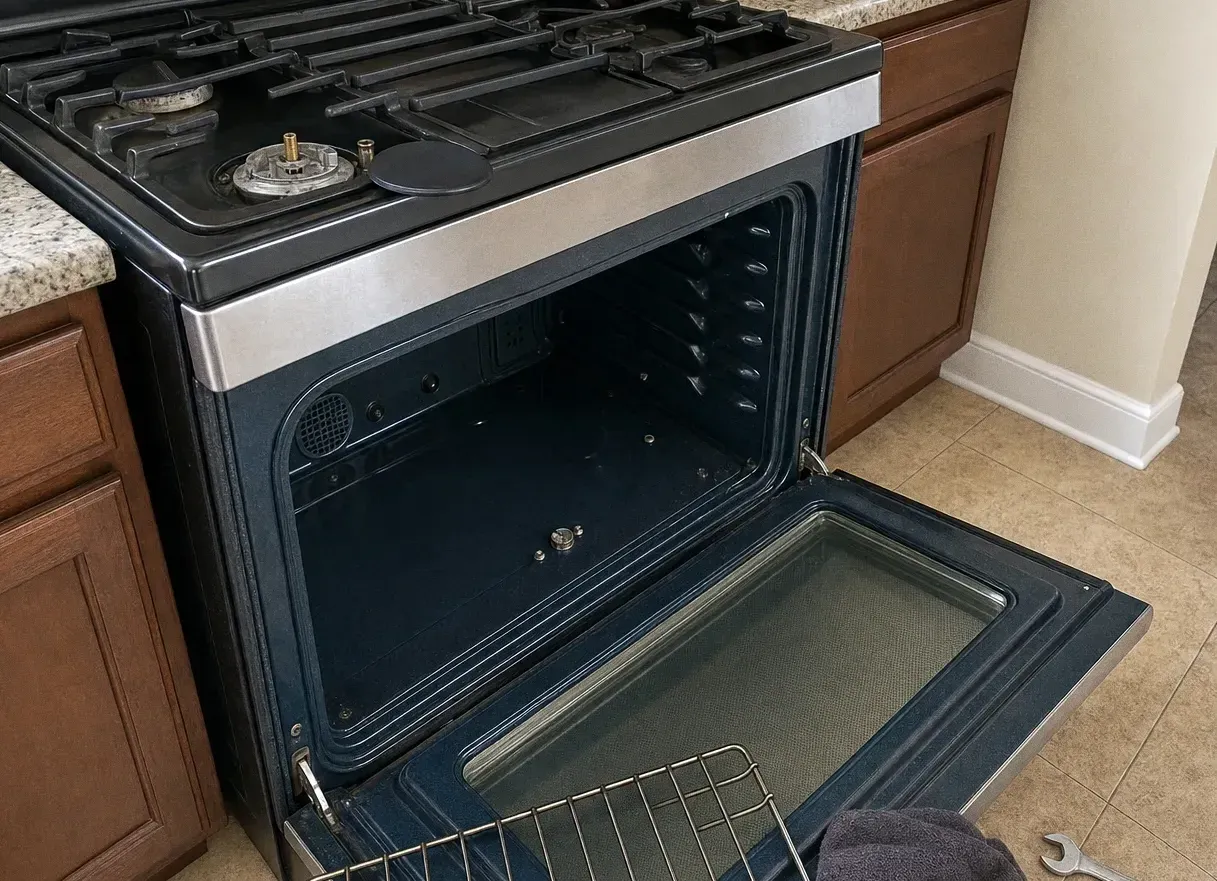
A burner that sparks and never catches is a strange thing to stand in front of, because everything you can perceive says the appliance is trying. The noise is there. Often the little flash is there. What is missing is silent and invisible, so the natural conclusion — the igniter has failed — is usually the wrong one.
The safety line comes first and stays first. A gas smell that will not clear once a window is open means everybody leaves the building and the gas utility is telephoned from outside. That call does not go to a repair company, and nothing in the rest of this page qualifies it.
The question that halves the problem
Make two lists before you touch the range. List one: burners that spark but produce no flame. List two: burners that produce no spark at all. Those are separate faults with separate causes, and mixing them together is why people end up buying parts they did not need.
Everything on the first list has a working spark system and something wrong on the gas side of that burner — the cap, the ports, or an electrode aimed at the wrong metal. Everything on the second list is electrical. And if both lists are full, meaning nothing on the top sparks or lights, the enquiry moves to what all the burners share: the module, its supply, and the earth it works against.
The noise itself is not evidence about fuel. It is the spark system reporting for duty, and treating it as a statement about gas sends people toward the wrong components every time. Note as well that a great many professional tops fire all their electrodes from one module, so a single knob commonly starts the entire row ticking. That is normal behaviour and not a third fault.
One symptom sits outside all of this: clicking that carries on with every knob in the off position. It gets its own section further down because the cause and the response are both different.
Where you are in Wellesley changes how urgent this feels rather than what is wrong. A house in Wellesley Farms with a second cooking area in the butler’s pantry can lose a burner for a week without much drama. In Wellesley Square, where a 30- or 36-inch range is wedged into one tight run of cabinets and is the only cooking there is, the same fault stops the kitchen.
The cap, the ports and the last time it was cleaned
Clear the mechanical possibilities quickly, because they are cheap to check and they account for a large share of the calls. A cap that never dropped into its locating notch, a port packed with hardened spill, or water left inside the head after a wash will all defeat a perfectly healthy spark.
Lift the cap and set it back deliberately. It should find one position and settle there rather than rocking or spinning. Look along the row at eye level afterwards; a cap sitting proud of its neighbours has something underneath it, and a fragment of grate coating is enough. A cap out of register redirects the flame path away from the spark gap, which is exactly the fault the electrode gets blamed for.
For ports, warm water and a soft brush, with a wooden toothpick for anything baked on. Keep steel away from them. A pin or a straightened paperclip will widen a port or fold its edge over, and unlike a blockage that is not reversible.
If the top has recently been cleaned, moisture is the likeliest answer and the cure is time. Water hides inside the head and around the ceramic at the electrode base where nothing dries it, and ignition stays suppressed until it has gone. There is no defensible number of minutes to give you; it depends on how wet it got and on the room. Wait longer than seems necessary before concluding that a part has failed.
The electrode: position, cleanliness and cracks
The electrode is where the electrical half of the range meets the gas half, and three things go wrong there. It ends up pointing at the wrong thing, its insulator cracks, or the gap it is supposed to jump gets bridged. All three produce clicking, which is what makes them so easy to misread.
Darken the room and look at a burner that lights properly. The spark is a tight blue-white snap crossing a short gap from the tip to the nearest edge of the burner head, in the same spot each pulse. Now look at the failing one. A spark reaching sideways toward a grate is landing where no fuel is present, and the module cannot tell the difference — it has no way of sensing where its energy went.
The white sleeve around the electrode is an insulator, and thermal shock cracks it: cold water onto a hot burner does it in one go. A cracked sleeve lets the pulse escape into the metal below before it reaches the tip. The click is unchanged, the burner is dead, and the whole thing frequently behaves worse in damp weather and better on a dry afternoon, so it gets reported as coming and going.
Carbonised residue between tip and head does the same by handing the spark an easier route than the air gap. Careful dry cleaning around the tip, with nothing abrasive, resolves a good number of them.
Is gas actually arriving?
When the spark checks out and the cap is right, stop looking at the burner and ask whether fuel is reaching the appliance. Light another gas appliance in the house. Find the shut-off behind or beside the range and confirm what position it is in, because it gets closed for cleaning or a delivery and forgotten. Ask whether there has been work in the street, a meter swap, or a plumber isolating a line.
Smelling for gas is not one of these checks, and it is worth being direct about why. Nothing is proved by the absence of a smell, and proving the presence of one means letting fuel gather in a closed room on purpose. Use another appliance as your test instead.
Past the shut-off, the fuel path is a technician’s work. The valve behind the knob, the manifold and the orifices are inside the appliance, they are not adjusted by feel, and there is no version of this where trial and error is the sensible approach.
Continuous clicking with everything off
This is the fault that brings most people to the phone, and it is genuinely electrical. The spark module is a small high-voltage supply. Each knob has a switch behind it that closes as the gas valve opens; the module reads that as a request, pulses the electrodes, and stops when the switch opens again. That is the entire logic, which is why a top clicking with all knobs off means the stop instruction never arrived.
Two causes dominate. A switch that no longer opens — contacts worn, or a spill that ran down the shaft behind the knob and set hard — leaves the module permanently commanded on. Or moisture bridges something behind the panel and creates a request nobody made. Both give the same symptom: constant ticking, sometimes with every burner off and cold, sometimes only after the top has been wiped down.
It also does not stay harmless. A module pulsing continuously runs the electrodes and their leads far beyond what they are built for, and it will keep going until the circuit is broken. Turn the range off at the breaker to stop it, leave the gas shut-off exactly as you found it, and book the visit.
Handing over here is not caution for its own sake. The switches, the harness and the module sit behind the control panel, inches from a live manifold, and the diagnosis needs the range powered to be worth anything. A visit is the $95 service call, and where an igniter or spark module replacement is the answer, that work runs $280 to $630. The Wolf Range Repair page sets out what gets checked on the ignition side.
Where to stop
The gas smell rule stands by itself: if it does not clear, leave and call the utility. After that, three symptoms mean the useful home checks are finished. Sparking that will not stop. A burner that lights several seconds late with a thump, which means fuel accumulated before it caught and is more pressing than a burner that never lights. And a burner that lights, holds and then goes out, which belongs to the flame-sensing side rather than to ignition.
What a technician establishes is measured, not judged by ear: whether the module maintains its output under load, whether the earth path it depends on is intact, whether gas is present at working pressure, and whether an individual switch is opening as it should. Any one of those can look fine from a kitchen and be wrong on a meter.
We cover Wellesley Hills, Wellesley Square and Cambridge on these calls. You already have what you need to reach us on this page — a number, and a booking link. If you can get a reading off the model plate behind the kick panel, quote it when you make contact.
Still asked
The burner keeps clicking even with every knob off.
The spark system has been left switched on by something that should have released it. Each knob works a switch that requests sparking, and when one of those refuses to return — worn contacts, or a spill that has set behind the shaft — the module goes on pulsing indefinitely. Isolate the range at the breaker so that it stops, then arrange for the panel to be opened by somebody who works on live equipment.
Can I clean the ports with a pin or a paperclip?
Avoid it. Anything stiff and steel can enlarge a port or fold the metal at its edge, and a burner with one distorted port never runs evenly again — you trade a blockage that could have been washed out for a defect that cannot be undone. Soak the head, then use warm water and a soft brush, with a wooden toothpick for stubborn deposits. Persistent blockage means the head comes off for proper cleaning.
I can smell gas. What should I do?
Leave, then call the gas utility from a safe distance outside. That is the entire instruction. Avoid touching light switches or anything else electrical as you go, leave doors open behind you if that is easy, and make no attempt to trace where it is coming from. The utility is responsible for making the building safe; appliance diagnosis happens afterwards and only afterwards.